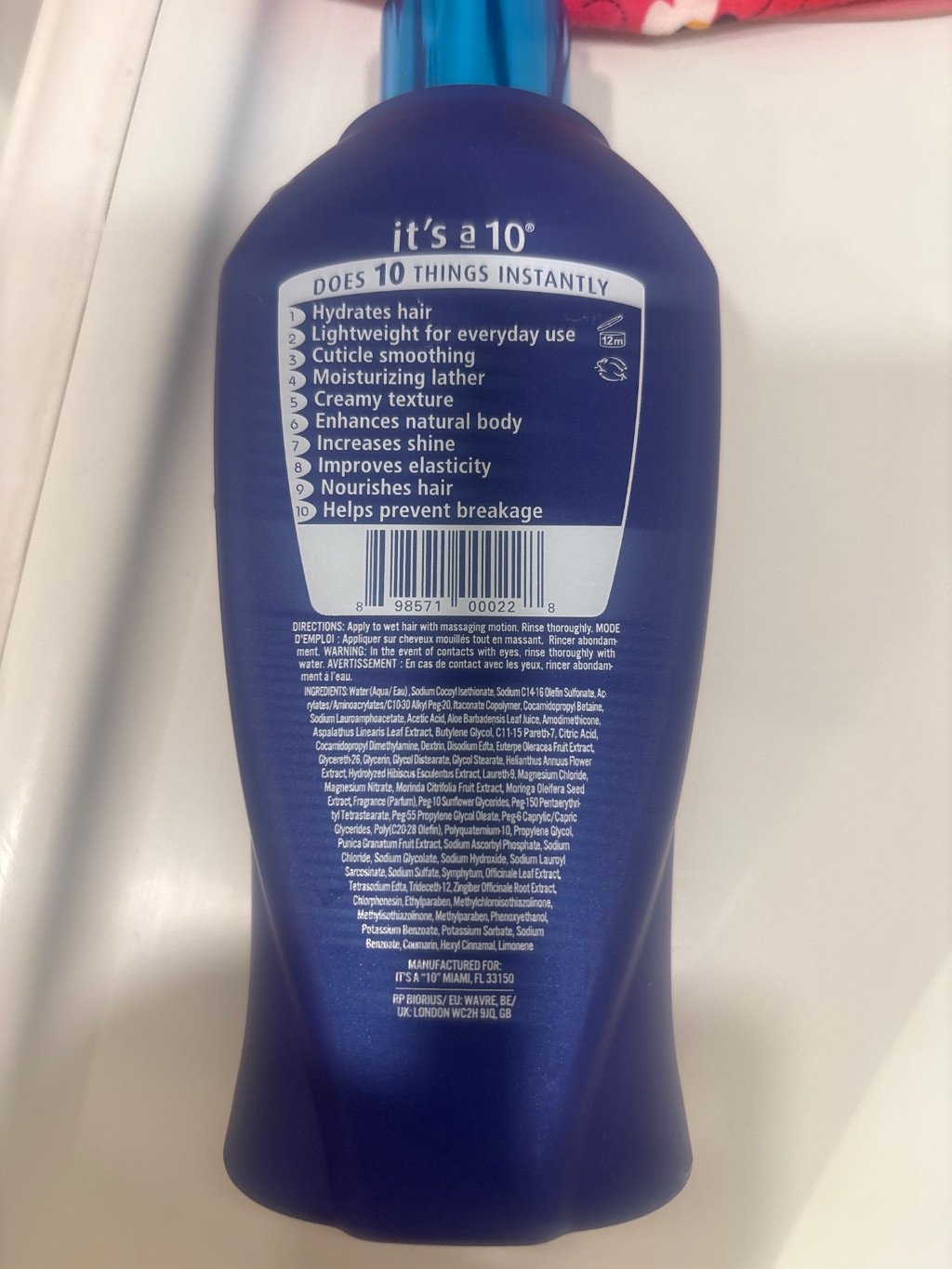
What is it's a 10 Miracle Shampoo?
it's a 10 Miracle Shampoo is a personal care product designed for cleansing and conditioning hair. Marketed to a broad audience seeking hair repair and nourishment, it falls into the rinse-off shampoo category. Unlike leave-in treatments, its primary function is to clean the hair and scalp before being rinsed away, which can influence the potential for ingredient absorption and exposure. The product aims to provide multiple benefits, often highlighting its blend of botanical extracts alongside synthetic ingredients.
The ingredient breakdown
This shampoo features a comprehensive ingredient list, blending numerous botanical extracts with a standard array of synthetic surfactants and conditioning agents. While many ingredients contribute to hair health and product performance, the formulation also includes several preservatives and an undisclosed fragrance blend, which are common points of concern in personal care products.
The cleansing foundation of the shampoo relies on surfactants like Sodium Cocoyl Isethionate, Sodium C14-16 Olefin Sulfonate, and Cocamidopropyl Betaine. These ingredients are effective at removing dirt and oil from hair and scalp and are generally considered safe for rinse-off applications. The product also incorporates beneficial botanical extracts such as Aloe Barbadensis Leaf Juice for soothing properties, Euterpe Oleracea (Acai) Fruit Extract and Punica Granatum Fruit Extract for their antioxidant potential, and Moringa Oleifera Seed Extract for hair nourishment. Glycerin is included as a humectant, helping to draw moisture into the hair.
A notable concern arises from the product's preservative system, which includes Methylchloroisothiazolinone and Methylisothiazolinone. These are potent sensitizers and known allergens, particularly for individuals with sensitive skin. While effective at preventing microbial growth, their use in personal care products has led to regulatory scrutiny due to their potential to cause contact dermatitis. Additionally, the shampoo contains Ethylparaben and Methylparaben, which are part of the paraben family of preservatives. Parabens have been a subject of debate due to their weak estrogen-mimicking activity, though regulatory bodies like the FDA currently consider them safe at typical usage levels.
The presence of Fragrance (Parfum) is another key area for consideration. This single term can represent a complex mixture of dozens to hundreds of undisclosed chemicals, some of which are common allergens. Specific fragrance components identified in this product include Coumarin, Hexyl Cinnamal, and Limonene. These are naturally occurring fragrance compounds that can act as skin sensitizers, meaning they can trigger allergic reactions in susceptible individuals upon repeated exposure.
The formulation also contains several PEG-compounds (Polyethylene Glycol derivatives) such as PEG-10 Sunflower Glycerides and PEG-150 Pentaerythrityl Tetrastearate. These ingredients function as emulsifiers, solubilizers, and conditioning agents. The primary concern with PEG-compounds is the potential for contamination with 1,4-dioxane, a byproduct of the ethoxylation manufacturing process. While manufacturers often purify these ingredients to remove contaminants, 1,4-dioxane is a probable human carcinogen according to the EPA.
Regulatory standing and hidden ingredients
Certain ingredients in it's a 10 Miracle Shampoo face stricter regulations in other parts of the world. For instance, Methylchloroisothiazolinone and Methylisothiazolinone, while permitted in rinse-off products in the US, are restricted to rinse-off products only within the European Union due to their strong sensitizing potential. This highlights a difference in regulatory approach, where the EU takes a more precautionary stance on ingredients known to cause skin allergies. Even in rinse-off products, the concentration of these preservatives is tightly controlled by EU authorities.
The term "Fragrance (Parfum)" represents an opaque blend, meaning manufacturers are not legally required to disclose its individual chemical components in the US. This trade secret protection allows a single ingredient listing to hide dozens of substances, including solvents, stabilizers, and other fragrance chemicals. Within this undisclosed blend, specific fragrance allergens like Coumarin, Hexyl Cinnamal, and Limonene are present. In the EU and UK, these specific allergens must be declared on the product label if their concentration exceeds certain thresholds, providing greater transparency for consumers with sensitivities.
What this means for your health
For the average consumer, using it's a 10 Miracle Shampoo as intended (a rinse-off product) generally limits the systemic absorption of ingredients. However, the presence of potent skin sensitizers like Methylchloroisothiazolinone/Methylisothiazolinone and various fragrance allergens (Coumarin, Hexyl Cinnamal, Limonene) means individuals with sensitive skin, eczema, or a history of contact allergies should exercise caution. Repeated exposure, even in a rinse-off product, can potentially trigger or exacerbate allergic reactions, leading to redness, itching, or irritation on the scalp or skin.
While the risk of 1,4-dioxane contamination from PEG-compounds is typically low due to manufacturing purification processes, it remains a potential concern for those seeking to minimize exposure to all possible contaminants. Pregnant individuals, young children, or those with compromised immune systems might choose to avoid products containing these ingredients as a precautionary measure, though current scientific consensus generally considers the risk from rinse-off products to be minimal for the general population.
Safer alternatives to consider
For consumers looking for alternatives with a lower risk profile, consider shampoos that are explicitly labeled "fragrance-free" or "unscented" to avoid undisclosed fragrance chemicals and common allergens. Look for products that utilize alternative preservative systems, such as those based on phenoxyethanol in combination with milder ingredients, or formulations that avoid parabens and isothiazolinones entirely. Opting for shampoos with simpler ingredient lists and those certified by third-party organizations for sensitive skin can also help minimize exposure to potential irritants and sensitizers.
The bottom line
it's a 10 Miracle Shampoo offers a blend of beneficial botanical extracts and effective cleansing agents, which can contribute to healthy hair. However, the inclusion of potent preservatives like Methylchloroisothiazolinone/Methylisothiazolinone, the use of an opaque fragrance blend containing known allergens, and the presence of PEG-compounds raise moderate concerns for sensitive individuals or those seeking to avoid certain chemicals. For the average user without sensitivities, it may be acceptable, but those with allergies or a desire for cleaner formulations should consider alternatives.