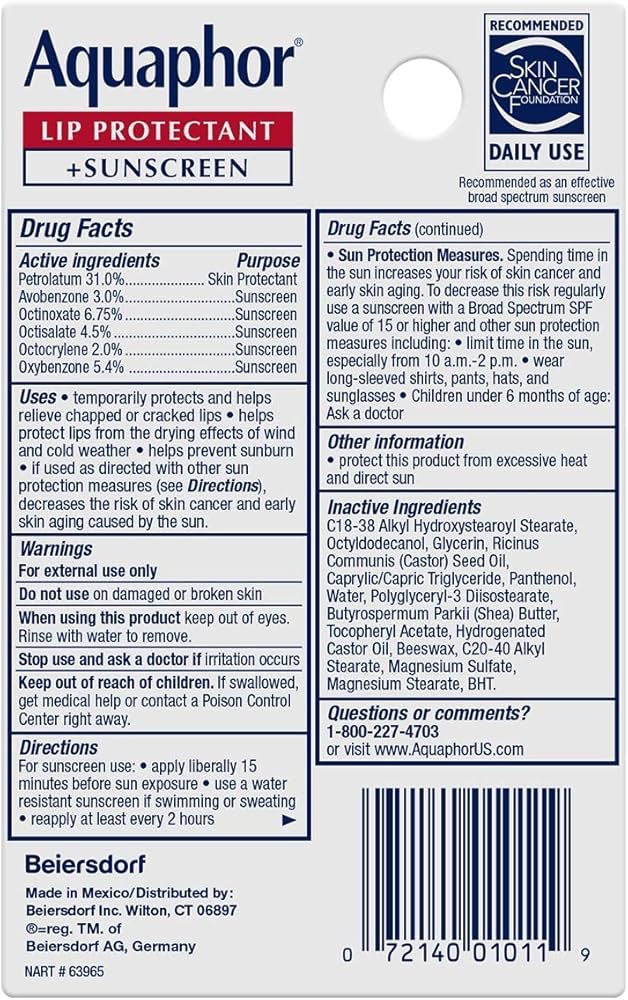
What is Aquaphor Lip Protectant + Sunscreen?
Aquaphor Lip Protectant + Sunscreen is a personal care product designed to moisturize and protect the delicate skin of the lips from sun damage. Marketed to a broad audience seeking relief for chapped lips and daily UV protection, it falls into the category of lip balms with added sun protection factor (SPF). Unlike mineral sunscreens that use zinc oxide or titanium dioxide, this product primarily relies on chemical UV filters to absorb and neutralize ultraviolet radiation, offering broad-spectrum defense against both UVA and UVB rays.
The ingredient breakdown
This lip protectant features a blend of approximately 20 ingredients, centered around a petrolatum base. Its primary function as a sunscreen is delivered by a combination of chemical UV filters, while several emollients and humectants contribute to its moisturizing and protective properties. The formulation is notably fragrance-free, which is a positive for those with sensitivities.
The core of this product's sun protection comes from its chemical UV filters: Oxybenzone, Avobenzone, Octinoxate, Octisalate, and Octocrylene. Oxybenzone, while effective at absorbing UV light, is a particular concern due to its classification as a potential endocrine disruptor. Studies suggest it can be absorbed through the skin and detected in the bloodstream, with some research indicating it may mimic estrogen and interfere with hormone systems. The FDA permits its use, but environmental concerns have led to restrictions in regions like Hawaii and Palau due to its toxicity to coral reefs. Avobenzone, Octinoxate, Octisalate, and Octocrylene are also chemical filters, generally considered less problematic than oxybenzone, but some have been linked to potential skin sensitization or, in high doses, mild endocrine activity.
Beyond sun protection, the product's base is Petrolatum, a highly effective occlusive agent that creates a barrier to prevent moisture loss, making it excellent for chapped lips. It also includes beneficial emollients like Ricinus Communis (Castor) Seed Oil and Butyrospermum Parkii (Shea) Butter, which help soften and smooth the skin. Glycerin and Panthenol act as humectants, drawing moisture into the lips, while Tocopheryl Acetate (Vitamin E) provides antioxidant benefits. These ingredients largely contribute to the product's moisturizing and healing claims.
Other ingredients include C18-38 Alkyl Hydroxystearoyl Stearate, Octyldodecanol, and Caprylic/Capric Triglyceride, which function as emollients or emulsifiers, ensuring a smooth texture and consistent application. A notable additive is BHT (Butylated Hydroxytoluene), an antioxidant used to prevent product degradation. While approved for use by regulatory bodies like the FDA, some studies have raised questions about its potential as an endocrine disruptor and allergen, though at the low concentrations typically found in cosmetics, the risk is generally considered low.
Regulatory standing and hidden ingredients
While Aquaphor Lip Protectant + Sunscreen is formulated with ingredients approved by the U.S. Food and Drug Administration (FDA) for over-the-counter use, one key ingredient, Oxybenzone, faces significant restrictions elsewhere. Specifically, it has been restricted or banned in regions such as Hawaii and Palau due to its documented toxicity to coral reefs and marine life. This highlights a divergence in regulatory focus, where environmental impact is a primary concern in some jurisdictions, even if direct human health risks are deemed acceptable by others for topical application.
What this means for your health
For most healthy adults using Aquaphor Lip Protectant + Sunscreen as directed, the immediate risks are generally low, especially given its effectiveness in preventing sun damage to the lips. However, the presence of chemical UV filters, particularly Oxybenzone, introduces considerations for certain populations. Oxybenzone's ability to be absorbed systemically and its potential as an endocrine disruptor means individuals who are pregnant, breastfeeding, or have hormone-sensitive conditions might prefer to avoid products containing it.
The realistic exposure risk for an average consumer is primarily linked to the systemic absorption of Oxybenzone. While the amount absorbed from a lip product is generally small, continuous daily use over time could lead to accumulation. For those concerned about minimizing exposure to potential endocrine-disrupting chemicals or those with sensitive skin prone to reactions from chemical sunscreens, opting for alternatives might be a prudent choice. The product's fragrance-free nature does, however, reduce the risk of fragrance-related sensitivities.
Safer alternatives to consider
Consumers seeking alternatives to chemical sunscreen lip protectants have several options that prioritize different ingredient profiles. Look for products that utilize mineral UV filters, such as zinc oxide or titanium dioxide, as their sole active ingredients. These minerals sit on the skin's surface, creating a physical barrier against UV rays, and are generally not absorbed into the bloodstream. Additionally, choose options that are explicitly fragrance-free and avoid ingredients like oxybenzone, octinoxate, and octocrylene, opting instead for simpler formulations with nourishing emollients.
The bottom line
Aquaphor Lip Protectant + Sunscreen offers effective broad-spectrum sun protection and excellent moisturizing benefits, making it a functional choice for daily lip care. Its fragrance-free formula is a plus for many. However, the inclusion of chemical UV filters, particularly Oxybenzone, which has known endocrine-disrupting potential and environmental concerns, warrants consideration. For average use, it provides protection, but those with specific health concerns or environmental consciousness may prefer to explore mineral-based alternatives to minimize exposure to these chemicals.